

The transition towards sustainable energy and chemical production requires more than generating renewable electricity: it also requires efficient ways of storing energy and making better use of renewable resources. The European research project PeCATHS is addressing these challenges by developing innovative photo-electrocatalytic routes that combine hydrogen storage with the valorization of biomass-derived molecules.
Within this multidisciplinary effort, the Institute of Advanced Materials (INAM) at Universitat Jaume I (UJI) is leading the project coordination, while also developing key components of the electrocatalytic system. The research at INAM/UJI focuses on an important principle at the heart of PeCATHS: both electrodes can contribute valuable products to the overall process.
Instead of using the conventional water-splitting reaction, in which one electrode produces hydrogen and the other oxygen, PeCATHS explores a different strategy. At one electrode, a molecule can be hydrogenated and thereby serve as a liquid organic hydrogen carrier (LOHC). On the other, a biomass-derived compound can be oxidized to produce a valuable chemical. The result is an electrochemical system in which renewable energy can simultaneously contribute to hydrogen storage and sustainable chemical production.
One of the challenges associated with the large-scale use of hydrogen is its storage and transportation. Hydrogen gas has a very low density and requires either high-pressure compression or energy-intensive liquefaction. LOHCs offer an alternative approach: instead of storing hydrogen as a gas, hydrogen is incorporated into the chemical bonds of an organic molecule. The resulting liquid can be handled and transported more easily, and the hydrogen can subsequently be released through a reverse reaction.
Within PeCATHS, the research at INAM/UJI investigates amine/nitrile pairs as LOHC systems, with benzonitrile and benzylamine serving as a model couple. In this system, the electrochemical reduction of benzonitrile (BZN) to benzylamine (BZA) allows hydrogen to be chemically stored in the liquid organic molecule. This approach provides an opportunity to connect hydrogen storage directly to renewable electricity. Rather than first producing hydrogen and subsequently using it to hydrogenate an organic carrier, the electrochemical process can transfer the required hydrogen equivalents directly into the carrier molecule.
The second half of the concept takes place at the opposite electrode turning biomass into a valuable product. At INAM/UJI, significant research effort has been dedicated to the design of anodes for the electrochemical oxidation of 5-hydroxymethylfurfural (HMF). HMF is a biomass-derived platform molecule that can be converted into 2,5-furandicarboxylic acid (FDCA), an important renewable building block with applications in the production of polymers and other chemicals. Replacing the conventional oxygen evolution reaction with biomass oxidation has several potential advantages. Oxygen evolution is kinetically demanding and requires a significant energy input, whereas the oxidation of suitable organic molecules can proceed at lower overpotentials while generating a useful chemical product. In this way, the anodic reaction is no longer simply a necessary counterpart to hydrogen production: it becomes a source of added value in its own right. This is a key aspect of the PeCATHS concept. By carefully designing the electrocatalysts and reaction conditions, the project aims to make productive use of both sides of the electrochemical cell.
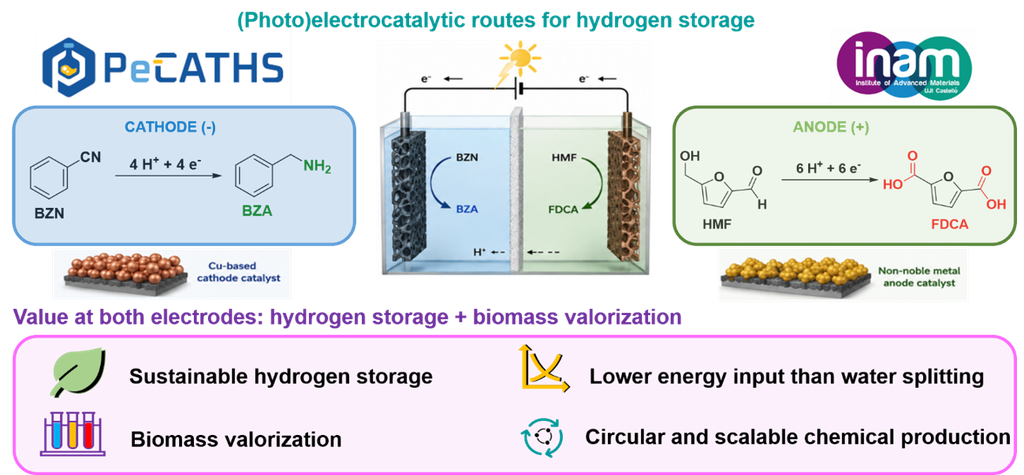
During the first 18 months of PeCATHS, the INAM/UJI team has therefore worked on two complementary challenges: the development of cathodes for benzonitrile reduction and anodes for HMF oxidation. The research has progressed from the design and evaluation of the individual electrodes to their integration in a two-compartment electrochemical cell. This step is particularly important because demonstrating each reaction separately is not sufficient to validate the overall concept. The two processes must also be able to operate together under compatible electrochemical conditions.
In preliminary experiments, the electrochemical system produced benzylamine and FDCA, demonstrating the feasibility of coupling the reduction of the nitrile-based LOHC precursor with the oxidation of the biomass-derived substrate. After seven hours of reaction, preliminary yields of approximately 90% for benzylamine and 100% for FDCA were obtained. These results constitute an important milestone for the project and, above all, provide the proof of concept that the proposed tandem electrochemical strategy can operate as intended.
The significance of these results goes beyond the production of two individual chemicals. The experiments demonstrate a new way of thinking about electrochemical energy conversion: the value of the process can be distributed across both electrodes. At the cathode, benzonitrile is reduced to benzylamine, creating a liquid molecule capable of storing hydrogen chemically. At the anode, HMF is oxidized to FDCA, transforming a biomass-derived feedstock into a higher-value product. This combination creates a form of global transfer hydrogenation, in which the hydrogen equivalents generated through the oxidation process are effectively coupled to the reduction process within the same electrochemical system. Rather than treating one electrode reaction as merely supporting the other, PeCATHS seeks to exploit both transformations simultaneously.
This is particularly attractive from a sustainability perspective. The approach connects three important objectives: renewable energy use, chemical energy storage and biomass valorization.
The successful operation of the integrated system represents an important achievement for the first stage of PeCATHS. It demonstrates that the fundamental chemistry proposed by the project can be implemented in an electrochemical cell and provides a solid basis for the next phase of research.
The challenge now is to move from proof of concept towards higher performance, stability and scalability. Future work will focus on optimizing the electrode materials and reaction conditions, improving selectivity and energy efficiency, understanding the mechanisms governing both reactions and ultimately integrating the electrocatalytic components with the project’s photoelectrochemical technologies.
Written by INAM team