

PeCATHs is driven by a commitment to tackling climate change, applying innovative materials science to the development of selective and stable electrodes and photoelectrodes. Meeting climate targets requires the rapid development of new materials, and this fundamentally begins at the atomic level. Within the Computational Chemistry Group at Trinity College Dublin (TCD), we are using high-performance computing to perform atomistic simulations of electrode materials, advancing our understanding of electrode operation and supporting the development of novel catalytic materials. This work forms part of work package 3 (WP3) of the PeCATHs project.
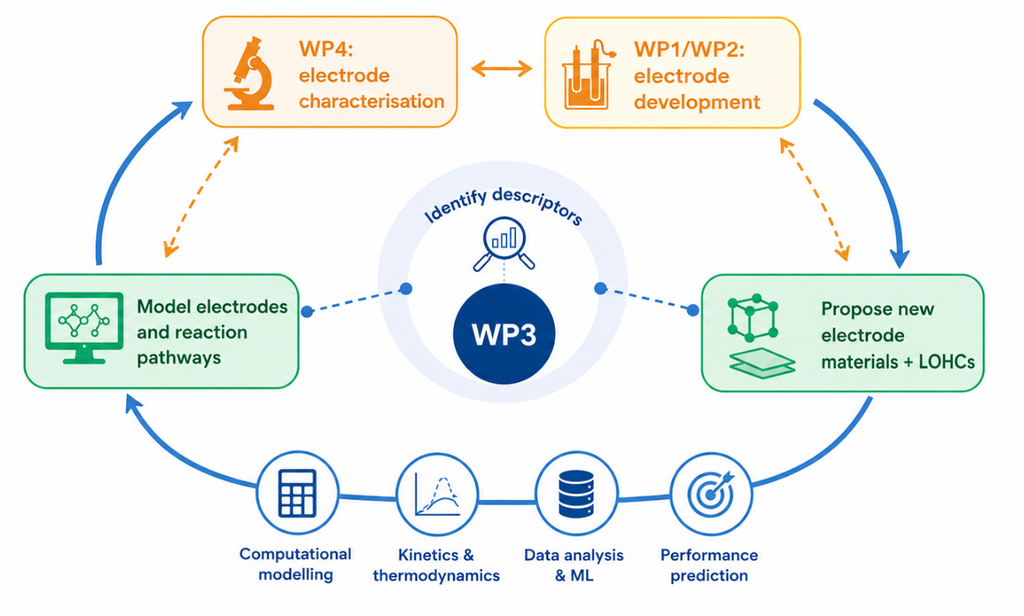
The state-of-the-art electrode materials employed in PeCATHs are both chemically and structurally complex, making the characterisation and simulation of their properties challenging. Furthermore, they undergo significant chemical changes during operation, depending on the applied potential, solution pH and choice of electrolyte. These challenges can be addressed through data-driven sampling of material configurations combined with thermodynamic analysis, allowing complex electrode structures to be resolved.
Modelling Electrode Materials at the Atomic Level
At TCD, we have been performing high-throughput calculations on the HMF oxidation electrocatalytic anode, sampling chemical composition, magnetic ordering, exposed surfaces and structural configurations. The thermodynamic data obtained from these simulations enable us to predict the structure and properties of the anode under specific operating conditions. These models are also being combined with the advanced characterisation work carried out by the Catalan Institute of Nanoscience and Nanotechnology (WP4), supporting the analysis of experimental data and incorporating these insights into our modelling.
These insights into the electrocatalytic anode support the work of the Institute of Advanced Materials at UJI (WP1) in optimising anode performance to maximise biomass valorisation. Working closely with these experimental partners and drawing on experimental data also helps improve our modelling approaches and theoretical understanding of the anode material.
A key strength of computational modelling is its ability to provide information that can be difficult to isolate experimentally. By examining electrode structures at the atomic level, we can investigate how changes in composition and local atomic environments influence properties such as stability, electronic structure and catalytic behaviour. In particular, our calculations can help establish which forms of the electrode are likely to be present under different experimental conditions, providing a foundation for understanding the active material during electrocatalysis.
Understanding Electrocatalytic Reaction Pathways
Building on these realistic electrode models, the next stage is to investigate the reactions taking place at their surfaces. Atomistic simulations allow us to examine individual steps in the oxidation of biomass-derived molecules and the reduction of LOHCs, including how reactants and reaction intermediates interact with different sites on the electrode surface. Comparing these pathways across different electrode structures and surface environments will help us understand the origins of catalytic activity and selectivity, and identify the atomic-scale features associated with improved performance.
Guiding the Development of New Electrode Materials
Looking ahead, the knowledge generated through WP3 will be used to guide the development of new electrode materials. By combining computational modelling, thermodynamics and data analysis, we aim to identify relationships between material structure and catalytic performance that can be used to screen and propose promising materials for experimental investigation.
This creates a feedback loop across PeCATHs: experimental characterisation improves the accuracy of our computational models, while predictions from those models can help guide the synthesis and testing of new electrodes.
Written by TCD